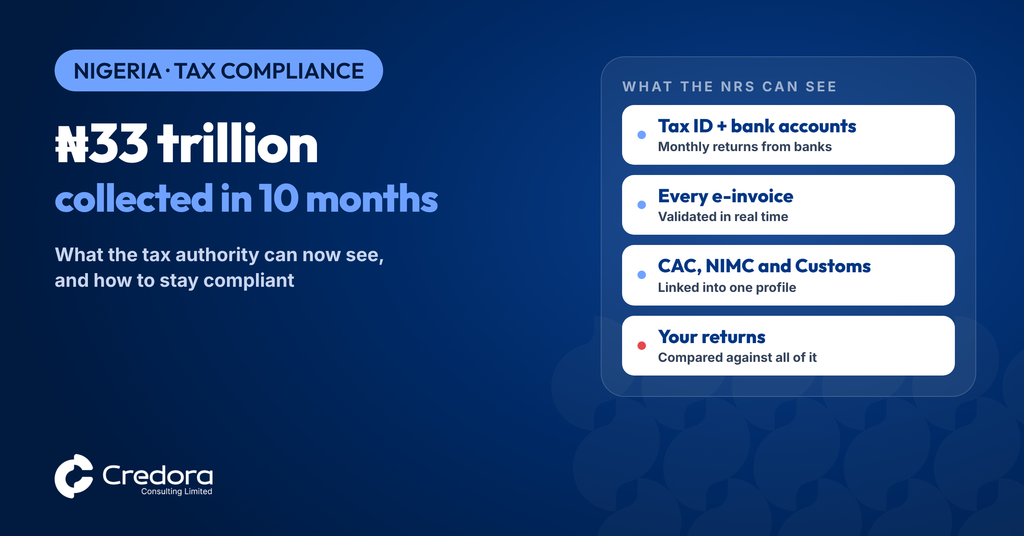
Tax compliance in Nigeria is under closer watch than ever. Nigeria collected about ₦33 trillion in revenue between January and October 2026, according to figures the Minister of Finance shared on 5 November 2026. That is already more than the ₦28.3 trillion collected in the whole of 2025, with two months of the year still to go. The full-year target is ₦40.7 trillion.
The rise is not only about higher rates. Since the new tax laws took effect on 1 January 2026, the Nigeria Revenue Service (NRS), the statutory successor to the Federal Inland Revenue Service (FIRS). It has built systems that let it see far more of what businesses and individuals actually do: who they bank with, what they invoice, what they import and who owns them.
For a business owner, this changes the question. It is no longer only “what do I owe?” but “does what I report match what the tax authority can already see?” This guide explains what the NRS can now see, how mismatches get picked up, what non-compliance now costs, and gives you a practical checklist for tax compliance in Nigeria.
Key numbers at a glance
1. Why collections have jumped
Four laws signed in 2025 came into force on 1 January 2026: the Nigeria Tax Act 2025, the Nigeria Tax Administration Act 2025 (NTAA), the Nigeria Revenue Service (Establishment) Act 2025 and the Joint Revenue Board of Nigeria (Establishment) Act 2025. Together they brought most federal taxes under one service and gave it stronger powers to collect data.
The government has linked the rise in collections to digital tax administration: a single Tax ID, electronic invoicing, automated filing and payment, and data shared between agencies. In simple terms, fewer transactions now happen out of the tax authority’s sight.
2. What the tax authority can now see
Your Tax ID and your bank accounts
Under section 4 of the NTAA, every taxable person must register and obtain a Tax ID. Section 8 makes the Tax ID a condition for opening or operating an account with a bank, insurance company, stockbroker or other financial institution. In practice, your business bank account is now linked to your tax record.
Banks and other financial institutions are treated as tax intermediaries. They must check that customers have a valid Tax ID and render monthly returns to the tax authority as set out in regulations. The NRS can also request information on a specific taxpayer, including account details and transaction records, as part of a review or investigation.
Your sales, through e-invoicing
Section 23 of the NTAA requires anyone making a taxable supply to use the Electronic Fiscal System to record and report transactions. In practice, businesses send each invoice electronically through the NRS Merchant Buyer Solution (MBS), usually through an approved Access Point Provider linked to their accounting software, where it is validated in real time.
Each e-invoice carries the supplier, the buyer, the items, quantities, prices and VAT. As one NRS official put it in July 2026: “If you say your turnover is ₦10 million, we can compare that with the invoice data.”
| Business size (annual turnover) | E-invoicing timeline |
|---|---|
| Large: ₦5 billion and above | Full integration was due by 31 July 2026 |
| Medium: ₦1 billion to ₦5 billion | Phased in from July 2026 |
| Small: below ₦1 billion | Integration expected by July 2027, with enforcement from January 2028 |
Your company records, imports and identity data
The NRS is building a single view of each taxpayer by bringing together data from banks, the Corporate Affairs Commission (CAC), the National Identity Management Commission (NIMC), the Nigeria Customs Service, the e-invoicing system and your own filings. That means it can link a company to its directors and shareholders, its imports, its bank inflows and its invoices.
Anything else it asks for
Under section 71 of the NTAA, the tax authority can require a taxpayer to provide information, books and records, and to give it access to records or data held electronically. Third parties, such as banks, can also be asked for information about you.
3. What this means for your business
The main risk now is a mismatch: a gap between what you report and what the data shows. The most common ones are:
- Turnover on your returns lower than your bank inflows or e-invoices. This is the first thing data matching picks up.
- VAT charged to customers but not filed or remitted. Your customers’ e-invoices and input VAT claims now point back to you.
- Staff on the payroll but PAYE not deducted or remitted. Salary payments leave a clear trail through your bank.
- Withholding tax deducted from suppliers but not remitted. The supplier may claim a credit that does not match your returns.
- Imports that do not match your declared costs or sales. Customs data now feeds into the same taxpayer profile.
- Company records out of date. Directors, shareholders or addresses at CAC that differ from your tax records slow everything down and can trigger questions.
None of this is new law on what tax is due. What is new is that the gaps are easier and faster to spot, often long before a field audit.
4. What non-compliance now costs
The NTAA has raised the cost of getting it wrong. The main penalties and charges include:
- Failure to deduct tax (for example PAYE or withholding tax): an administrative penalty of 40% of the amount not deducted, under section 105.
- Late payment: a penalty of 10% of the tax due, plus interest at a rate linked to the Central Bank’s Monetary Policy Rate (see how interest on late tax payment works).
- E-invoicing failures: ₦200,000 per transaction not processed through the Electronic Fiscal System, and a possible loss of the right to claim input VAT on affected purchases.
- Late filing and failure to register: separate fixed penalties, which add up quickly over several months.
- Bank access: without a valid Tax ID, your bank may restrict new accounts or transactions.
On top of the money, a tax dispute takes management time, can hold up government contracts and tax clearance certificates, and can put off lenders and investors.
5. How to stay compliant: a tax compliance checklist for Nigerian businesses
- Confirm your Tax ID for the company and each director, and make sure your banks hold the right one.
- Update your CAC records so directors, shareholders and addresses match your tax records.
- Reconcile monthly: compare your sales records, e-invoices and bank statements with what goes on your VAT and income tax returns, and note the reason for any difference.
- Separate business and personal accounts, so business income is not mixed with personal transfers, and keep a note of loans, capital injections and refunds.
- Prepare for e-invoicing: check your turnover band and deadline, choose an approved Access Point Provider and confirm that your accounting software can connect.
- Run payroll properly: deduct PAYE for every employee and remit it to the right state tax authority on time.
- Deduct and remit withholding tax where it applies, and issue receipts to suppliers.
- File on time, even when no tax is due. Small companies that qualify for 0% company income tax must still file returns.
- Keep records for at least six years, in a form you can produce quickly if the NRS asks.
- Fix past gaps early. Correcting an error before the NRS raises it is usually cheaper and easier than waiting for an assessment.
Practical scenarios
Scenario 1: the trading company with mixed accounts
Bola runs a distribution company in Lagos. Sales go into the company account, but some customers pay into her personal account, and she also moves money between the two. The company files turnover of ₦80 million, while total inflows across both accounts are about ₦130 million.
If the NRS compares the figures, it will ask about the ₦50 million gap. Some of it is transfers between her own accounts and a family loan, which are not income, but she has no records to show this. What to do: move all customer payments to the company account, keep a simple monthly reconciliation and document loans and transfers.
The result: every naira in her accounts can be explained, so an NRS query becomes a quick reply rather than an assessment on income she never earned.
Scenario 2: the manufacturer moving onto e-invoicing
A Kano manufacturer with turnover of about ₦3 billion still issues paper invoices from an older accounting system. Its large customers are already on e-invoicing and are starting to ask for validated invoices so they can claim input VAT.
What to do: confirm the timeline for its turnover band, appoint an approved Access Point Provider, test the connection with its accounting system and train the finance team before the deadline. Delays risk ₦200,000 per non-compliant invoice and unhappy customers.
The result: invoices are validated in real time, customers can claim their input VAT, and the business avoids penalties when its deadline arrives.
Scenario 3: the services firm with unremitted withholding tax
A consulting firm in Abuja deducts withholding tax from some supplier payments but has fallen behind on remitting it. Its suppliers are now claiming credits for tax that does not appear in the NRS records.
What to do: work out what is outstanding, remit it with any interest due, and file the missing returns. Acting before the NRS writes to you limits the penalties.
The result: supplier credits match the NRS records, the penalties stay as low as possible and supplier relationships are protected.
Frequently asked questions
Can the NRS see every transaction in my bank account?
Banks must report to the tax authority as set out in regulations, and the NRS can request account details and transaction records for a specific taxpayer during a review. It does not mean every transfer is taxed. You only pay tax on taxable income, but you should be able to explain large differences between your inflows and your returns.
Will money sent to me by family be taxed?
Gifts, loans and transfers between your own accounts are not income. The best protection is a clear record, such as a note or loan agreement, that shows what the money was for.
My business is small. Does e-invoicing apply to me yet?
The NRS is rolling e-invoicing out in phases, starting with large businesses. Smaller businesses are expected to follow by 2027 to 2028. It is worth checking which band you fall into now and making sure your accounting system can connect when your turn comes.
I made mistakes in past returns. What should I do?
Speak to an adviser, work out the correct position and correct it. Coming forward and paying what is due is usually far cheaper than waiting for the NRS to find the gap through data matching.
What happened to FIRS?
The Federal Inland Revenue Service (FIRS) has transitioned into the Nigeria Revenue Service (NRS), its statutory successor. The NRS now collects federal taxes such as company income tax, VAT and withholding tax. State tax authorities still collect PAYE and other personal income tax from residents of their states.
Key takeaways
- Nigeria collected about ₦33 trillion between January and October 2026, already more than the whole of 2025.
- The NRS can now link your Tax ID, bank accounts, e-invoices, CAC records and imports into one profile.
- The biggest risk is a mismatch between what you report and what the data shows.
- Penalties are higher: 40% for failure to deduct, 10% plus interest for late payment and ₦200,000 per non-compliant e-invoice.
- Monthly reconciliation, separate accounts, up-to-date records and early correction of past errors are the best protection.
Related reading: Nigeria Tax Reform Checklist 2026: Is Your SME Ready?
How Credora can help
At Credora Consulting, we help businesses in Nigeria get their tax position in order and keep it that way. We can:
- Review your returns against your bank and sales records
- Set up monthly reconciliations so mismatches never build up
- Get you ready for e-invoicing, from choosing an Access Point Provider to testing your software
- Run your payroll and withholding tax so deductions are made and remitted on time
- Correct past errors before they turn into assessments
Book a free consultation and we will review your records and show you where the gaps are.
Book your free consultationOr email us at info@credoraconsulting.com.ng
General information, not tax advice. This article reflects the Nigeria Tax Act 2025, the Nigeria Tax Administration Act 2025 and NRS announcements as at November 2026. E-invoicing timelines, reporting rules and penalties may change as the NRS issues further regulations and guidance. Names in the scenarios are illustrative. Please take professional advice on your own circumstances.
Sources: Ecofin Agency, Nigeria collects $24.5 billion in 10 months as digital tax reforms advance (November 2026); Nigeria Tax Administration Act 2025, sections 4, 8, 23, 71 and 105; Nigeria Tax Act 2025; TechCabal, Nigeria’s biggest tax reform turns business invoices into real-time economic data (23 July 2026); Technext, How NRS’ new e-invoicing rules could reshape corporate tax compliance (July 2026); Leadership, Smarter Tax, Wider Net: Inside NRS’ Digital Revenue Revolution (August 2026); BMO & Co, Key elements of tax digitalisation and technology under the Nigeria Tax Administration Act 2025; ThisDay, New Tax ID Law (September 2025); Lagos State Internal Revenue Service, Mandatory use of Tax ID in all official and transactional documents.