
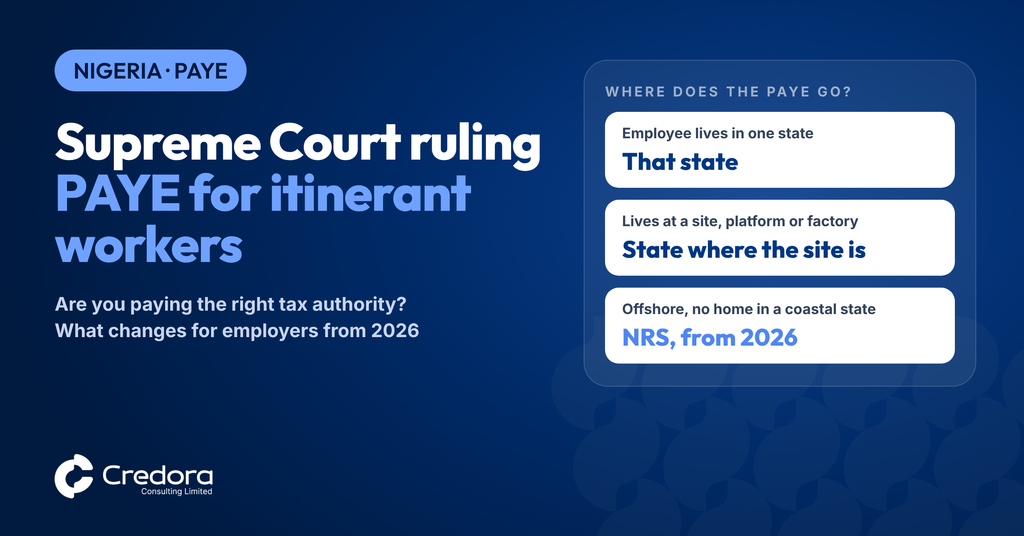
If your staff work across more than one state, on a site, a rig or a factory away from head office, a recent Supreme Court judgment on PAYE for itinerant workers is worth your attention. In FIRS v Attorney General of Bayelsa State, reported on 12 November 2026, the Court held that the state tax authority, not the federal tax authority, has the power to collect personal income tax from itinerant workers.
The case is about PAYE that two employers paid to the federal tax authority for staff working on an offshore oilfield between 2011 and 2017. Bayelsa State said the money belonged to it, and the dispute took about eight years to settle. The lesson for every employer is simple: PAYE for itinerant workers, and for any employee, must go to the right tax authority. If it goes to the wrong one, the authority that is entitled to it may still assess you, and recovering the money can take years.
This guide explains what the Court decided, who counts as an itinerant worker, how to work out which authority should receive each employee’s PAYE under the Nigeria Tax Act 2025, an important change for offshore workers from 2026, and the checks to make now.
Key numbers at a glance
1. What the Supreme Court decided on PAYE for itinerant workers
Between July 2011 and May 2017, Pacific Inter Drilling West Africa Limited and the Nigerian Content Development and Monitoring Board deducted PAYE from staff working on the Agbami Oilfield and paid it to the Federal Inland Revenue Service (FIRS).
Bayelsa State’s Board of Internal Revenue argued that this was a mistake: the workers were itinerant workers, and their tax belonged to the state. In 2018 the Joint Tax Board agreed with Bayelsa, and FIRS initially accepted that a refund was due. It then changed its position, arguing that the oilfield lies about 70 km offshore, in Nigeria’s Exclusive Economic Zone, outside any state’s territory, so the federal government could collect the tax.
The case went through the High Court (2020) and the Court of Appeal, and both found that Bayelsa’s Board was the right authority. The Supreme Court has now confirmed it:
- The laws FIRS relied on do not deal with personal income tax for people working in the Exclusive Economic Zone or territorial waters.
- The relevant provision clearly gives the state tax authority the power to collect tax from itinerant workers.
- The employees in this case were itinerant workers, so the Bayelsa State Board of Internal Revenue, not FIRS, was the right collector.
2. Which workers count as itinerant for PAYE?
An itinerant worker is an individual, whatever their status, who works in more than one state during the year for wages, salary or a livelihood, for at least 20 days in at least three months of the year. Government security officers are excluded.
This definition comes from section 108 of the Personal Income Tax Act (the old law that applied in this case), and the same wording is carried into the interpretation section, section 202, of the Nigeria Tax Act 2025. It does not appear in the Twelfth Schedule, which sets the residence rules discussed below.
In practice, this can include:
- rig, platform and flow-station crews on rotation
- construction and project staff who move from site to site
- sales representatives, drivers and logistics staff who cover several states
- technicians and engineers who spend weeks at client locations
- self-employed artisans and contractors who work across state lines
For employees on a payroll, PAYE for itinerant workers is hardest to get right when it is not obvious where they live. For self-employed itinerant workers, states often collect tax through assessments or withholding tax on payments made to them.
3. Which tax authority gets PAYE for itinerant workers and other staff?
From 1 January 2026, the Nigeria Tax Act 2025 (Twelfth Schedule) and the Nigeria Tax Administration Act 2025 decide which authority collects each employee’s tax. The main rules are:
| Employee’s situation | Who receives the PAYE | How it is decided |
|---|---|---|
| Works for a Nigerian employer and lives in one state | That state’s internal revenue service | Place of residence on 1 January, or on the day they start the job |
| Has places of residence in two or more states | The state of the principal place of residence | Usually the place nearest to where they work |
| Has places of residence in two or more states and works at an operational site (oil terminal, platform, flow station, factory, quarry, or construction site with at least 50 workers) | The state where the operational site is | Twelfth Schedule, paragraph 12(d): the site is treated as the principal place of residence |
| On leave on 1 January | The state they lived in just before the leave began | Twelfth Schedule, paragraph 2 |
| Armed forces, police (non-civilian) and Foreign Service officers | Nigeria Revenue Service (NRS) | Nigeria Tax Administration Act, section 3(1)(a) |
| Lives offshore in the Exclusive Economic Zone, with no principal residence in a coastal state | NRS (from 2026) | Twelfth Schedule, paragraph 3(2) |
Residence is fixed once a year. If an employee moves from Lagos to Ogun in June, their PAYE for that year usually stays with the state they lived in on 1 January, and moves to the new state from the following January.
The operational-site rule applies only where an employee has places of residence in two or more states and works at the site. An employee with a single home is resident where that home is. For construction sites, the Act sets a threshold of at least 50 workers but does not say how they are counted, for example whether contractors’ staff are included. If your site is near that number, keep a headcount record and take advice.
4. Offshore itinerant workers: PAYE rules change from 2026
The Supreme Court decided the case under the old Personal Income Tax Act, for tax years 2011 to 2017. The Nigeria Tax Act 2025 now deals directly with the question the Court had to answer.
Under paragraph 3(2) of the Twelfth Schedule, an employee whose place of residence is in Nigeria’s Exclusive Economic Zone or territorial waters beyond the coastal (littoral) states, and who has no principal place of residence in any coastal state, is treated as a person whose tax is administered by the Nigeria Revenue Service.
- For years before 2026: the Supreme Court’s approach applies. Itinerant workers’ tax belongs to the state tax authority.
- From 1 January 2026: offshore employees with no principal residence in a coastal state are dealt with by the NRS. Offshore crew who do have a principal residence in a coastal state, such as Rivers, Bayelsa, Delta or Lagos, remain with that state.
5. Why getting it wrong is expensive
- The entitled authority may still assess you. If PAYE goes to the wrong authority, the authority that is entitled to it may still raise an assessment while the money sits elsewhere.
- Recovery is slow. In the Bayelsa case, the dispute started in 2018 and was only settled by the Supreme Court in 2026.
- Penalties apply to the employer. Under the Nigeria Tax Administration Act 2025, failing to deduct tax attracts a penalty of 40% of the amount not deducted. Tax deducted but not remitted on time attracts a 10% annual penalty plus interest at the Central Bank of Nigeria monetary policy rate.
- Your annual return must match. Employers must file a return of all employees’ pay by 31 January each year, and PAYE paid to the wrong state will not reconcile with the right state’s records.
The Nigeria Tax Administration Act 2025 requires tax deducted to be remitted by the 21st day of the following month. Some state tax authorities still publish an earlier date, often the 10th, so confirm the deadline with each state you pay.
6. PAYE for itinerant workers: what employers should do now
- List every employee and where they lived on 1 January 2026, including staff who live at site camps, terminals, platforms or factories.
- Flag anyone who works in more than one state, or for 20 days or more in at least three months of the year away from their base.
- Check each person against the rules in section 3 and confirm the authority you should be paying.
- Review offshore staff separately under the 2026 rule for the Exclusive Economic Zone.
- Register with every state tax authority you need to pay, and keep proof of each month’s remittance.
- If you find past PAYE paid to the wrong authority, take advice before moving anything. Agree the position with both authorities, in writing, rather than simply switching payments.
Practical scenarios
Scenario 1: A construction company with a site in another state
Ade’s company is based in Lagos and is building a warehouse in Ogun State. Sixty workers live in a site camp in Ogun for most of the year, and several of them also keep family homes in Lagos.
Because the Ogun site has at least 50 workers, it counts as an operational site. The workers who have homes in both Lagos and the Ogun camp have places of residence in two states and work at the site, so the site is treated as their principal place of residence, and their PAYE is likely to belong to Ogun State. Workers whose only home is the camp are resident in Ogun anyway. Office staff who live only in Lagos stay with Lagos.
Scenario 2: An oil-services company with offshore crew
Ngozi runs payroll for an oil-services firm with crew on a platform about 70 km offshore. Most crew members live in Port Harcourt between rotations. Three expatriate engineers have no home in Nigeria other than the platform.
Crew who principally live in Port Harcourt belong to Rivers State. From 2026, the three engineers, who live only in the Exclusive Economic Zone and have no principal residence in a coastal state, fall under the Nigeria Revenue Service. For PAYE paid in earlier years, the Supreme Court’s approach favours the state, so any past arrangements should be reviewed with an adviser.
Scenario 3: An SME with sales staff across three states
Emeka’s distribution business has five sales representatives who cover Lagos, Ogun and Oyo, each spending more than 20 days a month on the road. All five live in Lagos and lived there on 1 January.
They may meet the definition of itinerant workers, but as employees with a clear home in Lagos on 1 January, their PAYE is paid to Lagos State. Emeka keeps a record of each address as at 1 January, so he can show why Lagos is the right authority if another state asks.
Frequently asked questions
Does this ruling change where I pay PAYE for itinerant workers?
Only if you are currently paying the wrong authority. Most employers with staff in one state are unaffected. Businesses with site-based, offshore or multi-state staff should check each employee against the residence rules.
Can I get back PAYE paid to the wrong authority?
It may be possible, but it is rarely quick, and the entitled authority may still assess you in the meantime. In the Bayelsa case, the Joint Tax Board was asked to confirm the right authority before the matter went to court. Since 1 January 2026, its role has passed to the Joint Revenue Board, and tax disputes can also go to the Tax Appeal Tribunal. Take advice before you change where you pay.
What if an employee moves to another state during the year?
Residence is generally fixed by where the employee lived on 1 January, or on the day they started the job. Their PAYE usually moves to the new state from the following January.
Does the ruling apply to the years since 2026?
The ruling interprets the old law. From 2026, the Nigeria Tax Act 2025 has its own rules, including a specific rule for people living offshore in the Exclusive Economic Zone. For most onshore employees, the result is the same: tax goes to the state of residence.
What about remote workers?
An employee who works from home for a Nigerian employer is resident in the state where they live, so their PAYE goes to that state, even if your office is in another state.
Where someone in Nigeria works for a foreign employer with no presence in Nigeria, the Nigeria Tax Act 2025 still treats them as resident in the state where they live (Twelfth Schedule, paragraph 1). The foreign employer will not usually run Nigerian PAYE, so the employee must register with their state tax authority, file an annual return and pay the tax themselves. Individual returns are due by 31 March after the end of the year.
Key takeaways
- The Supreme Court has confirmed that the state tax authority, not the federal authority, collects personal income tax, including PAYE for itinerant workers, under the old law.
- PAYE belongs to the state where the employee is treated as resident, usually decided by where they lived on 1 January.
- Employees with homes in two or more states who work at an operational site, such as a terminal, platform, factory, quarry or construction site with at least 50 workers, are usually treated as resident where the site is.
- From 2026, offshore employees with no principal residence in a coastal state fall under the Nigeria Revenue Service.
- If PAYE goes to the wrong authority, the entitled authority may still assess you, and recovery can take years.
How Credora can help
At Credora Consulting, we help employers in Nigeria set up and review payroll so that every employee’s PAYE, including PAYE for itinerant workers, goes to the right authority, on time. We can map your workforce by state, review site and offshore staff under the 2026 rules, register you with the right state tax authorities, and help resolve past payments made to the wrong authority.
Book a free consultation and we will review where your staff are resident and where their PAYE should be paid.
Book your free consultationOr email us at info@credoraconsulting.com.ng
General information, not tax advice. This article reflects the Supreme Court judgment in FIRS v Attorney General of Bayelsa State & Anor as reported on 12 and 13 November 2026 (the date the judgment was delivered had not been published in those reports), the Nigeria Tax Act 2025 and the Nigeria Tax Administration Act 2025. The application of residence rules depends on the facts, and tax authorities may issue further guidance. Names in the examples are illustrative. Please take professional advice on your own circumstances.
Sources: BusinessDay, State governments have the exclusive authority to collect personal income tax from itinerant workers (November 2026); TheNigeriaLawyer, States, not FIRS, collect itinerant workers’ income tax (November 2026); Personal Income Tax Act, section 108; Nigeria Tax Act 2025, Twelfth Schedule and section 202; Nigeria Tax Administration Act 2025, sections 3, 14, 105 and 107; Nigeria Revenue Service (Establishment) Act 2025; Joint Revenue Board of Nigeria (Establishment) Act 2025; PwC Worldwide Tax Summaries, Nigeria: Individual tax administration; Mondaq, Taxation of employment income under the Nigerian tax reform Acts (March 2026); KPMG Nigeria, Navigating the tax landscape for itinerant workers in Nigeria (2025).