
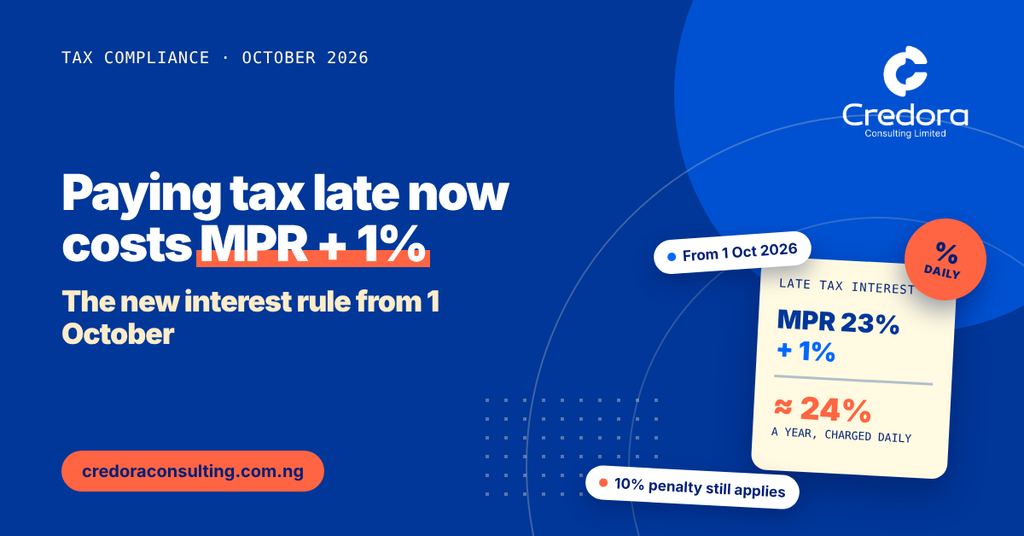
Paying Tax Late Now Costs MPR + 1%: The New Interest Rule From 1 October
If your business sometimes pays tax a few weeks late and promises itself it will catch up, this one is for you. The rules on interest on late tax payment in Nigeria changed on 1 October 2026, and the cost of paying late is now tied directly to the Central Bank’s interest rate.
The good news is that the new rate is lower than the old one. The not-so-good news is that interest now runs every single day until the tax is paid, so small delays still add up.
What changed on 1 October 2026?
The Minister of Finance issued the Nigeria Tax Administration (Interest on Late Payment of Tax) Order, 2026, under the Nigeria Tax Administration Act 2025. It replaces the 2017 notice on interest for unpaid tax and applies to the Nigeria Revenue Service (NRS), every State Internal Revenue Service and the FCT Internal Revenue Service.
Here is the new rule in plain terms:
- Tax payable in naira: interest is charged at the CBN Monetary Policy Rate (MPR) plus 1 percentage point, with a floor equal to the yield on 364-day Treasury Bills.
- Tax payable in foreign currency: interest is charged at SOFR plus 6 percentage points.
- How it is calculated: simple interest, charged daily, from the day the tax was due until the day it is paid.
- Monthly rate: the rate for each month is set on the last business day of the month before, and the NRS publishes it on its website by the third business day of the month.
Under the old rules, the spread was 5 percentage points. Cutting it to 1 point is a real relief, but it does not make late payment cheap.
What could paying late cost you?
After its September 2026 meeting, the CBN set the MPR at 23%. That puts the naira interest rate at around 24% a year, as long as it stays above the Treasury Bill floor.
Example: a company pays a ₦2,000,000 company income tax balance 60 days late
| What you pay | Amount |
| Interest: ₦2,000,000 × 24% × 60 ÷ 365 | ₦78,904 |
| 10% late-payment penalty | ₦200,000 |
| Total cost of paying 60 days late | ₦278,904 |
Remember that the 10% late-payment penalty under Section 65 of the Act has not changed. Interest comes on top of it.
What about tax that was already overdue?
The new rate applies to interest arising from 1 October 2026, including on tax that fell due earlier. Interest that built up before 1 October stays under the rules that applied at the time.
Tax authorities can still waive interest or penalties under Section 66 if you can show good cause. That is a request you make, not something that happens automatically, so keep evidence of any genuine reason for delay.
Practical scenarios
Scenario 1: “It’s only 10 days late”
Tolu’s company pays a ₦500,000 company income tax balance 10 days after the deadline.
The result: interest is ₦500,000 × 24% × 10 ÷ 365 = ₦3,288. The 10% late-payment penalty adds ₦50,000. A 10-day delay costs about ₦53,288, and most of that is the penalty, not the interest. Even a short delay is expensive.
Scenario 2: Paying part now, the rest later
Chidi’s company owes ₦3,000,000. It pays ₦2,000,000 on time and the remaining ₦1,000,000 90 days later.
The result: interest only runs on the ₦1,000,000 that was paid late. That’s ₦1,000,000 × 24% × 90 ÷ 365 = ₦59,178. Paying what you can on time keeps the interest down, because interest is charged on the unpaid balance.
Scenario 3: Tax that was already overdue before 1 October
A company had ₦1,000,000 of tax due on 1 August 2026 and finally pays it on 31 October 2026.
The result: the old rules apply to the interest for August and September. From 1 October, the new rate applies, so October adds about ₦1,000,000 × 24% × 30 ÷ 365 = ₦19,726. Old debts don’t escape the new rule. They simply switch over to it from 1 October.
Scenario 4: A genuine reason for the delay
A business misses its payment date because its bank’s system failed on the deadline day, and it pays the next morning.
The result: interest and penalties still apply automatically. However, under Section 66 the business can ask the tax authority to waive them for good cause. It should keep evidence, such as the bank’s notice and payment records, and make the request quickly.
Frequently Asked Questions
For tax payable in naira, it is the CBN Monetary Policy Rate (MPR) plus 1 percentage point, with a floor equal to the yield on 364-day Treasury Bills. With the MPR at 23%, that is about 24% a year.
1 October 2026, under the Nigeria Tax Administration (Interest on Late Payment of Tax) Order, 2026.
Yes. It is simple interest, charged daily from the day the tax was due until the day it is paid.
The rate for each month is set on the last business day of the previous month. The NRS publishes it on its website by the third business day of each month.
Yes. The 10% penalty under Section 65 of the Nigeria Tax Administration Act 2025 has not changed. Interest is charged on top of it.
No. They are separate. Filing a return late attracts its own penalty of ₦100,000 for the first month and ₦50,000 for each month after, even if you have paid.
How to avoid late payment interest
- Know your dates.
Put every tax deadline (VAT, PAYE, withholding tax and company income tax) in one shared calendar with reminders.
- Set money aside monthly.
Move tax money into a separate account when you invoice, not when the deadline arrives
- File on time, even if you can’t pay in full.
Filing late attracts its own penalties, separate from interest.
- Speak to the tax authority early.
If cash is tight, ask about payment arrangements before the deadline, not after.
- Keep your books current.
You can’t plan for tax you haven’t calculated.
How Credora can help
The new rule is fairer than the old one, but it is also stricter. Interest now runs every single day, the 10% penalty still applies, and every tax authority in the country follows the same rule. A few weeks of delay can quietly cost your business hundreds of thousands of naira, money that could have gone into stock, salaries or growth.
The businesses that never worry about late payment interest aren’t lucky. They simply know their deadlines, set money aside early and keep their books up to date.
At Credora, we make sure tax never catches your business by surprise. We can:
- set up a clear tax calendar for VAT, PAYE, withholding tax and company income tax
- keep your books up to date so you always know what you owe
- prepare and file your returns on time
- review any overdue tax, work out your exposure and help you deal with the tax authority, including waiver requests where there’s good cause
Don’t let interest keep running on your tax.
If you have tax that’s overdue, or you’re not sure your deadlines are under control, talk to us today. The sooner it’s sorted, the less it costs.
Book your free accounting consultation
Or email us: info@credoraconsulting.com.ng
Follow us for more practical tax and finance tips:
FACEBOOK
INSTAGRAM
This article is general information, not tax advice for your specific situation.