How the ₦100 million turnover and ₦250 million fixed-assets test works, what the relief covers, and what to keep on file.
Nigeria’s new tax framework gives qualifying small companies a 0% company income-tax rate and exempts them from the 4% development levy. But “small” is a defined tax category, not simply a description of a young or modest-sized business. To assess eligibility, a company must check both its annual gross turnover and total fixed assets, understand which tax provision is being applied and keep records that support its position.
The Nigeria Tax Act 2025 took effect on 1 January 2026. The edited Act published by the National Assembly defines a small company using a ₦100 million annual gross-turnover ceiling and a ₦250 million fixed-assets ceiling. This guide explains the two-part test, what the relief covers, what it does not cover and what a business should do as it grows.
Key numbers at a glance
The small-company test has two parts
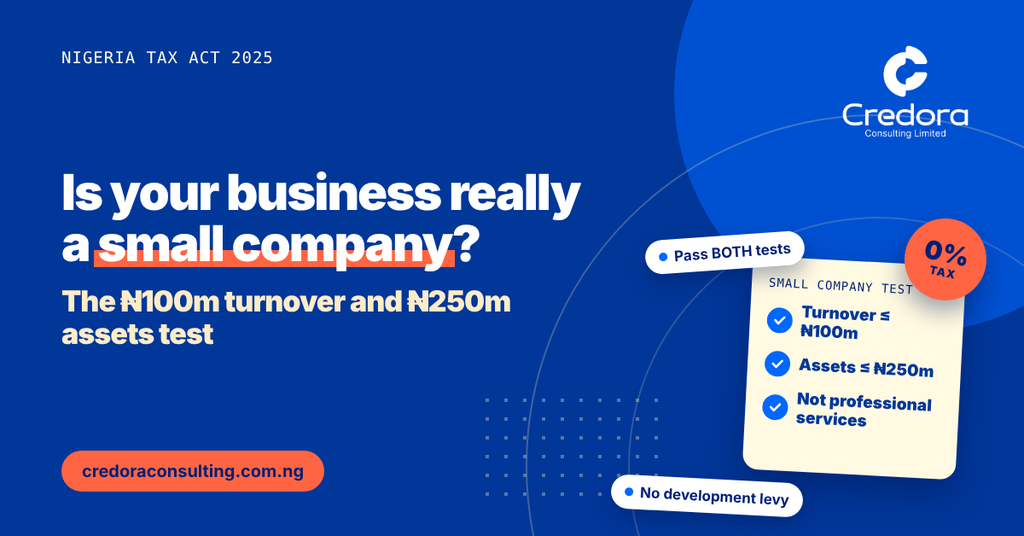
Under the edited Nigeria Tax Act 2025, a company must satisfy both limits to fall within the small-company definition:
- Annual gross turnover: ₦100 million or less for the relevant year.
- Total fixed assets: not more than ₦250 million.
A company that exceeds either ceiling should not assume that it qualifies simply because it passes the other test. For example, turnover below ₦100 million does not cure fixed assets above ₦250 million. Likewise, assets below the cap do not compensate for turnover above ₦100 million.
The Act does not make company age, headcount, incorporation date, profit level or the owner’s description of the business a substitute for these tests. A new company can be outside the category, while an established company may qualify if it meets the statutory conditions. Where the accounting records or classification are unclear, obtain professional advice before filing on the basis of the exemption.
How to read turnover and fixed assets
Gross turnover is not the same as profit. Turnover broadly concerns business receipts from operations before deducting operating costs, but the specific treatment of unusual receipts, related-party transactions and one-off disposals should be checked against the Act and the company’s circumstances. Do not use the cash balance in a bank account as a shortcut for turnover.
The fixed-assets test also calls for careful accounting. A company should review its asset register and financial statements, including the assets it owns and uses in the business. Do not assume that inventory, cash, a lease, or an item held for resale belongs in the fixed-assets figure without checking the applicable accounting and tax treatment. Keep the basis for the figure documented and consistent.
The statutory wording is “not exceeding” ₦250 million, so exactly ₦250 million is within that numerical ceiling. Exactly ₦100 million is also within the turnover ceiling. A small change in the accounts can matter, so recheck the figures for each relevant year rather than relying on last year’s classification.
Examples of how the test works
| Business example | Annual turnover | Fixed assets | Initial reading |
|---|---|---|---|
| Fashion retailer | ₦85m | ₦40m | Within both numerical limits; review the relevant activities and records. |
| Logistics company with a truck fleet | ₦70m | ₦300m | Above the fixed-assets ceiling; it does not pass both tests. |
| Manufacturer | ₦120m | ₦200m | Above the turnover ceiling; low assets do not change that result. |
| Consulting or professional-services firm | ₦30m | ₦5m | Get a written classification: the NTAA’s small-business definition expressly excludes professional services. |
What tax relief does small-company status provide
Section 56 of the Nigeria Tax Act sets the company income-tax rate for a small company at 0%. Section 59 imposes a 4% development levy on assessable profits of companies, except small companies and non-resident companies. For a company that qualifies under the applicable rules, this means no company income tax at the small-company rate and no development levy under that section.
A 0% company income-tax rate is not the same as being outside the tax system. It does not mean that the company can ignore its tax registration, returns, books or obligations connected with staff, suppliers and taxable transactions. Small-company relief also should not be confused with VAT exemption: the NTAA contains a separate small-business definition and separate VAT rules. Check each tax separately.
The relief concerns tax liability under the provisions described above. It does not automatically erase prior liabilities, penalties, outstanding returns or tax obligations for periods governed by earlier law. The Ministry of Finance transition guidance says accounting periods ending before 1 January 2026 are treated under the previous tax framework, while periods ending from that date onward are administered under the new Acts.
Professional services and other classification questions
The NTAA’s small-business provisions expressly say that a business providing professional services is not a small business. That point matters especially when considering administrative relief, including the NTAA’s small-business framework for VAT. However, section 202 of the edited NTA defines a “small company” with the ₦100 million and ₦250 million tests and does not repeat the professional-services phrase in that definition.
This difference means an article or informal checklist should not promise that a professional-services firm is excluded from, or automatically entitled to, every tax relief. The particular tax and section must be identified. A consulting, legal, accounting, engineering, medical or other professional practice should document its activities and ask for specific advice on company-income-tax treatment, development levy and VAT administration before relying on small-company status.
Small companies still have compliance work
A company’s tax rate and its filing obligations are separate questions. The NTA and NTAA contain registration, return, payment, recordkeeping and administration requirements. A small company should confirm the exact return and filing process that applies to its legal form, accounting period and tax activities, and should not treat a nil or zero tax liability as permission to skip a required filing.
Depending on the company’s activities, other obligations may include:
- Tax identification and registration with the relevant tax authority, including keeping company particulars current.
- Company tax filings and supporting accounts or statements required for the company and its accounting period, even when the resulting tax due is zero.
- PAYE deduction and remittance for employees, together with payroll records and required employee filings.
- Withholding tax deduction and remittance where the company makes payments that attract withholding tax.
- VAT and transaction reporting where applicable under the separate VAT rules. Do not infer VAT status solely from the company-income-tax threshold.
- Books and supporting documents that allow the company to explain how turnover, assets and tax figures were calculated.
Requirements can depend on the type of activity, jurisdiction and tax period. Build a compliance calendar and confirm deadlines and submission channels with the Nigeria Revenue Service or the relevant state tax authority.
Records to prepare before claiming the relief
A practical small-company file should let an accountant or tax officer trace the figures in the eligibility test back to underlying records. Keep the following together for each relevant accounting period:
- Reconcile gross turnover. Tie sales invoices, receipts, bank records and accounting ledgers to the annual turnover figure. Explain material differences and one-off transactions.
- Update the fixed-asset register. Record each material asset, acquisition or disposal, date, cost, supporting invoice and the accounting treatment used.
- Retain signed financial statements and ledgers. Keep trial balances, management accounts, tax computations and reconciliations used to support the filed return.
- Document the business activities. Maintain contracts, invoices, licences and a description of the company’s services or products, especially if professional-services classification could arise.
- Keep tax and payroll evidence. Retain tax registration details, filed returns, acknowledgements, payment evidence, payroll records and withholding-tax schedules as relevant.
The tax authority may request supporting information. A number entered in a return is much easier to defend when the company can show how it was calculated and reconcile it to its books.
What happens as the company grows
Small-company status is not permanent. A growing company should review its turnover and fixed assets before each year-end and during the year when a large contract, new branch, equipment purchase or acquisition could move it close to a limit. The company should model the tax and compliance impact before making decisions that change its scale or structure.
If either threshold is exceeded, the company should not continue applying the exemption automatically. Determine the effect for the relevant accounting period, update tax forecasts, confirm which tax rate and levy rules apply, and meet the filing and payment requirements. Do not assume a grace period, a carry-forward allowance or an exemption for part of the year unless a specific provision or official guidance supports it.
If the company is close to a limit, timely bookkeeping is especially important. A delayed reconciliation can make it harder to know when a threshold was crossed or to budget for tax. Keep a running turnover report and current asset register, and ask an adviser to review the position before filing.
A practical checklist for Nigerian businesses
- Confirm the period. Identify the accounting period and whether it falls under the previous tax rules or the Nigeria Tax Act framework effective from 1 January 2026.
- Calculate both tests. Determine annual gross turnover and total fixed assets from reconciled records; do not assess only one threshold.
- Check the business activity. Identify whether a professional-services exclusion or another specific rule applies to the tax relief being considered.
- Separate taxes. Review company income tax, development levy, VAT, PAYE and withholding tax independently.
- File and retain evidence. Confirm the applicable returns and deadlines, submit required filings and preserve the calculations and supporting documents.
- Reassess as you grow. Refresh the turnover and asset tests annually and when material business changes occur.
How Credora can help
Credora Consulting Limited helps Nigerian businesses of all sizes and sectors check their position under the new tax rules before they rely on an exemption. If you are close to either threshold or provide professional services, a documented review can help you understand which provisions apply.
- Check: we review your turnover and fixed-asset records against the two-part test.
- Classify: we flag classification questions, including whether a professional-services rule could apply.
- Organise: we put your supporting documents in order so every figure can be traced to your books.
- Plan ahead: we help you prepare your tax compliance calendar and filings, and review your position as you grow.
Not sure whether your company qualifies?
Book a consultation with Credora Consulting Limited and we will help you assess your company’s position under Nigeria’s new tax rules.
Frequently asked questions
What is the turnover limit for a small company in Nigeria?
The edited Nigeria Tax Act 2025 defines a small company as one with annual gross turnover of ₦100 million or less and total fixed assets not exceeding ₦250 million. Both limits apply.
Does a company have to pass both the turnover and asset tests?
Yes. A company must be within both limits to pass the numerical test. Exceeding either the ₦100 million turnover ceiling or the ₦250 million fixed-assets ceiling means the company should not assume it qualifies.
Does a small company pay company income tax?
Section 56 sets the company income-tax rate for a small company at 0%, if the company qualifies under the Act. The zero rate does not by itself remove registration, recordkeeping or filing requirements.
Does a small company pay the 4% development levy?
Section 59 excludes small companies from the 4% development levy on assessable profits. Confirm that the company qualifies for the relevant period and keep records supporting its classification.
Are professional-services businesses excluded?
The NTAA expressly excludes businesses providing professional services from its “small business” definition. The edited NTA small-company definition is worded differently. Because the answer can depend on which tax relief is being considered, professional-services companies should obtain a specific written classification rather than assume the same rule applies to every tax.
Are small companies exempt from VAT?
Do not infer VAT treatment from the company-income-tax definition. The NTAA has separate small-business and VAT provisions, including its own definition and rules. Check those provisions against the company’s taxable supplies and activities.
Do small companies still have to file tax returns?
A zero company income-tax rate does not automatically remove filing duties. Confirm the required returns and supporting statements for the company, its tax activities and accounting period, and keep proof of submission.
What records should a small company keep?
Keep sales and bank records that reconcile to gross turnover, an up-to-date fixed-asset register, invoices for asset purchases and disposals, financial statements, tax computations, tax filings, and relevant payroll and withholding-tax records. Document the nature of the company’s business activities as well.
What if the company exceeds one limit during the year?
Reassess its status and the applicable tax treatment for the relevant period. Do not assume a grace period or continue using the exemption without checking the Act and obtaining advice. Update forecasts and comply with the filing and payment rules that apply.
When did the new tax rules take effect?
The Nigeria Tax Act 2025 took effect on 1 January 2026. The Ministry of Finance transition guidance says tax periods ending before that date remain under the previous framework, while periods ending from that date onward are administered under the new Acts.
General information, not tax advice. This article is general information for Nigerian businesses and does not replace advice on your specific business. Tax treatment depends on the applicable law, accounting period, business activities and records. Confirm your position with the Nigeria Revenue Service, the relevant tax authority or a qualified tax adviser.
Sources and legal references
- Nigeria Tax Act 2025, sections 56, 59 and 202 (edited Act published by the National Assembly). https://nass.gov.ng/documents/download/11249
- Nigeria Tax Administration Act 2025, including the “small business” definition and administration/VAT provisions. https://www.nrs.gov.ng/uploads/NIGERIA_TAX_ADMINISTRATION_ACT_2025_8c945071a7.pdf
- Federal Ministry of Finance, General Guidelines for implementation of the Tax Acts 2025 and transition dates. https://finance.gov.ng/ministry/federal-government-issues-transition-guidelines-for-tax-acts-2025/